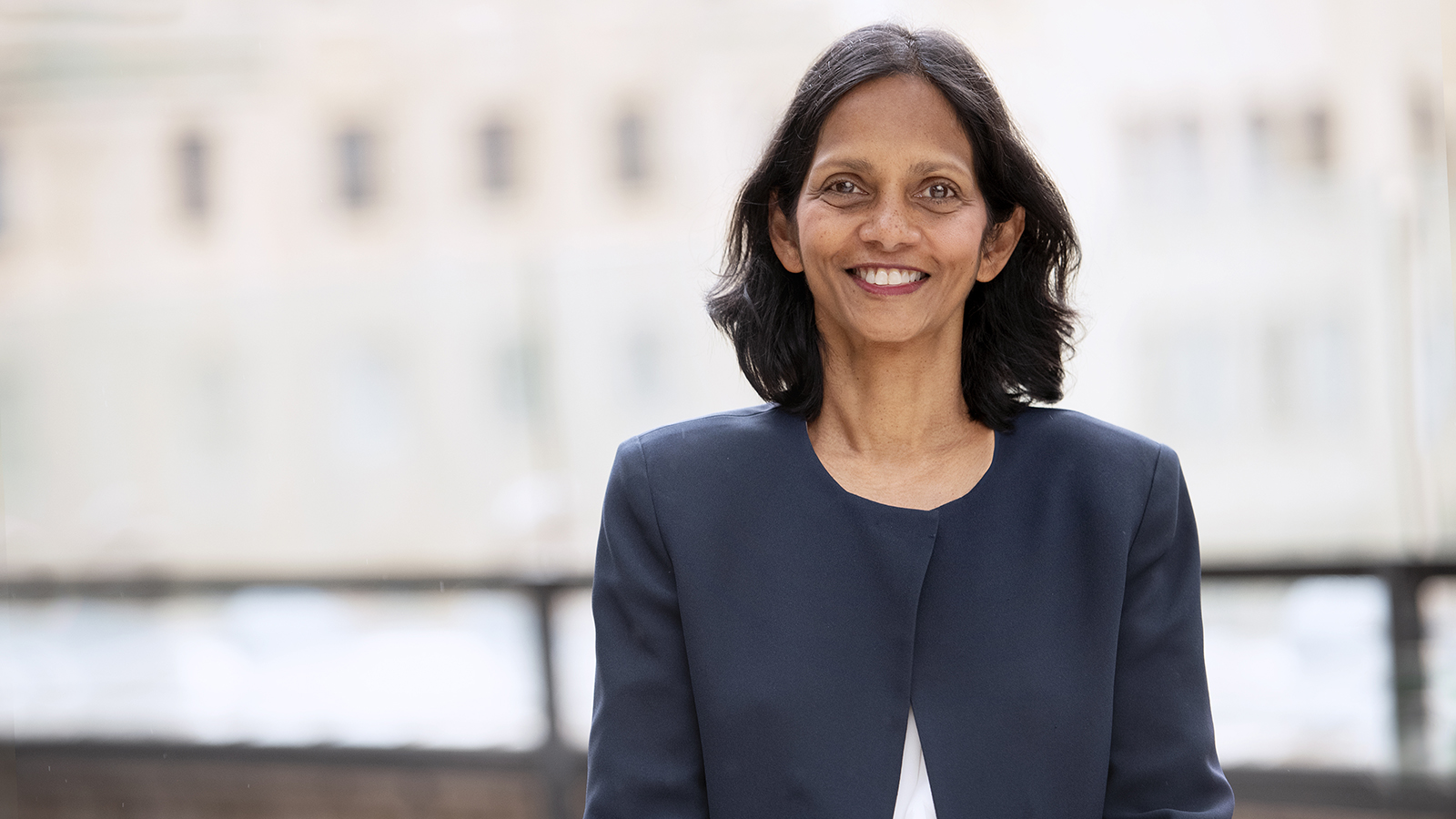
When Shemara Wikramanayake arrived at Ascham in Year 8, it was her fifth school on her third continent. By then, constant change had come to define Shemara’s lived experience and it was a reality in which she thrived. Although her family’s moves were sometimes dictated by financial hardship, Shemara’s natural curiosity saw her embrace each new circumstance as an opportunity to learn from different perspectives and cultures.
‘We were shaped by the circumstances of moving a lot,’ reflected Shemara, who is of Sri Lankan heritage. Born in the UK, she returned to Sri Lanka at just three months old before moving back to the UK eight years later with her family.
‘The constant moving helped me be open to change. And I actually loved it,’ she said, when addressing a room of Ascham alumni at the AOGU Business Breakfast last year.
On what would be the family’s final big move from the UK to Australia when she was 13, Shemara, her two siblings and their parents all had a say. However, her father ‘exercised his right to veto’ his children’s wishes to stay put with their friends in the UK, and they packed their bags one last time. ‘All we’d seen about Australia was Skippy and the bush, eucalyptus trees,’ said Shemara, but once they landed, Australia became home.
Shemara (Class of 1979) and her older sister Roshana completed their schooling at Ascham, where she says they received a ‘fantastic technical education. The academic training we got was phenomenal.’ Shemara’s parents were extremely encouraging of all their children to follow a career of their choosing. ‘Dad always led all three of us to believe that whatever country we were in, we could be anything we wanted,’ said Shemara. ‘Our parents were very empowering.’
After completing a law degree at UNSW Sydney and a year at Blake Dawson Waldron working on mergers and acquisitions, Shemara joined Macquarie Capital’s investment banking team in 1987. She retires from Macquarie in November this year after almost 40 years with the firm, having been Macquarie Group CEO since late 2018. Her remit spans 30 markets globally and around 19,000 staff.
Shemara’s rise through Macquarie reflects her unparalleled business acumen and ability to empower diverse teams of smart, talented people. Not to mention, taking her place in boardrooms where women have been conspicuously underrepresented. As one Australian Financial Review article noted, Shemara well and truly ‘busted the stereotypical assumption that being male, white and egotistical is a prerequisite for success in the testosterone-driven world of investment banking.’
As the first female CEO of Macquarie Group and one of the first women to lead an ASX 200 company, Shemara has been recognised by Forbes, Fortune and TIME for her influence in business and on some of the defining challenges of our time, including climate transition response.
She has worked for the advancement of women in both the financial services sector and leadership more broadly. At Macquarie, Shemara has led strategic programs to increase diversity and encourage more women and girls to consider a career in finance.
‘We need the richest possible combination of different ages, genders, cultural and racial backgrounds, diversity of sexual orientation and socio-economic backgrounds and experiences—and regardless of any disability,’ she said at a Chief Executive Women event in 2020. ‘This allows us to challenge each other’s perspectives in forming better collective decisions, improves understanding of regional and sectoral nuances and gives us greater empathy in serving a much broader client and community base. It also makes for a much more interesting workplace. Working to ensure diversity of thought and capability is critical. My main message to girls out there is: why let boys have all this fun?’
If there’s a recurrent theme in Shemara’s approach, one that she speaks of often, it’s that where there’s challenge there is always opportunity. ‘What we need is solutions,’ she said at the AOGU Business Breakfast, ‘and human beings have been very good at doing this.’
As Shemara shared, despite Monday night cramming to finish her assignments and a few ‘detentions’ for missed deadlines, she credits Ascham and the Dalton Plan with providing an education that ensured self-direction (‘just getting things done’) and a binding sense of community. She still regularly catches up with her Ascham peers, who she says all support each other, and referenced her friend and fellow banking CEO Jane Fraser (of Citigroup). ‘There are two women CEOs of global investment banks around the world. We both went to Ascham. It’s just mind blowing,’ she said.
When Shemara Wikramanayake retires this year from Macquarie Group, she will do so having redefined what’s possible in leadership. For four decades she has broken ground for women in a firmly male-dominated sector, and shown what leadership looks like when it is talent and tenacity, not tradition, that determines opportunity.
Bibliography:
Hislop, M (2020), ‘Dismissing prejudice as “irrational” has been key to CEO Shemara Wikramanayake’s resilience & leadership’, Women’s Agenda
Kehoe, J (2013), ‘Macquarie’s brightest star’, The Australian Financial Review
Read our previous instalments of 14 Decades of Stories:
Pioneering feminist and first Ascham student Inez Bensusan
Brilliant scholar Ethel Lane Latham, who was the highest scoring female student in NSW in 1894 and 1895
Bessie Bundock, co-founder of Ascham’s yearbook, Charivari, which has become the School’s continuous primary historical record for over 120 years
Rania MacPhillamy MBE OBE operated vast rest homes for wounded soldiers in Egypt during World War I
An original Ascham audio drama brings to life the 1915 letters of Ursula Carter who worked as a nurse during World War I
Mother and daughter Linda and Patricia Littlejohn, who smashed the glass ceiling in university and empowered women across society
Ascham Old Boy Lloyd Poulton, who was one of a handful of boys who were enrolled at Ascham early in the 20th century
Inspiring obstetrician and gynaecologist Dr Joan Storey, whose determination and excellence opened doors for women in medicine
After overcoming a life-changing accident, Charlene Meade OAM became a Paralympic pioneer
One of Australia’s most influential radiologists and medical researchers Dr Janet McCredie AM
The life of Belinda Hutchinson AC has been one of generosity, leadership and service