Just as this series, 14 Decades of Stories, highlights some of our inspirational graduates, back in 1902 three industrious Ascham girls set out to capture the spirit of our School. Together they employed their curiosity and resourcefulness to publish the first editions of our annual yearbook, Charivari, which from its humble, handwritten beginnings has become an enduring—and we would argue the most significant—form of Ascham’s historical record.
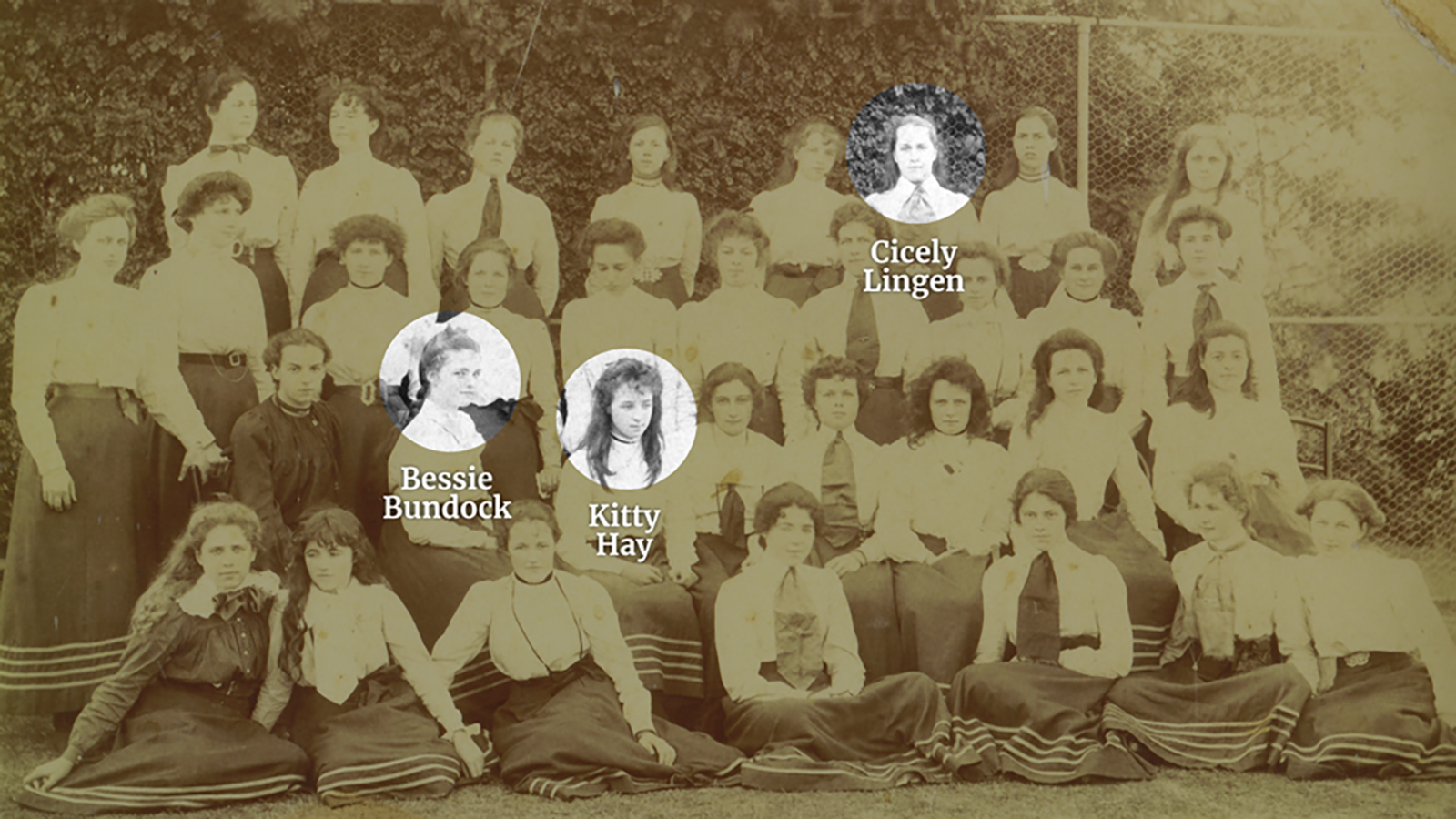
Bessie, Kitty and Cicely. Our accidental archivists.
Without them, we would not have over 120 years of an archival record that offers extensive documentation of all the School’s eras: the students who have attended, their creative writing, artworks and their voices, the teachers and Heads who have educated and led here, the subjects and buildings that have come and gone, the lives of our boarders, the sports, the traditions, all the colour and character of campus.
But more than that, Charivari contributes enormously to the wider public record—reflecting social and cultural history, changes in values, expectations and social norms across decades, offering insight into how global events such as world wars, economic downturns and political movements shaped everyday School life, preserving language and attitudes, and revealing times when opportunities for young women were evolving in response to wider social change.
According to Bessie Moseley (Bundock 1904), in an oral history conducted with her shortly before her death in the early 1980s, she, Kitty Hay and Cicely Lingen ‘did everything together’. The idea to start Charivari was Kitty’s, and together they produced the earliest couple of editions. When the others left Ascham, Bessie carried it on alone before passing the responsibility for its continuance to Headmaster Mr Carter when she left school in 1904.
Although we do not have a copy of the first edition or two published in 1902, the Ascham Archives holds every edition since the 3 April 1903 issue in all its precious handwritten, hand-drawn glory. Its cover illustrates Mt Adelaide, Ascham’s home at the time, and our original motto Non doctrina solum sed virtute (‘Not education alone, but virtue’). Inside, the pages record a lively and affectionate portrait of Ascham life, with illustrations by Kitty: a cricket match between day girls and boarders, a rainy camping trip, the ‘Breaking Up’ (last day of school), student arrivals and departures, a music program, and a humorous Lost and Found entry for ‘finding my long lost muscles since I indulged in Swedish Drill’! Every detail offers an invaluable glimpse into the personality of both the students and Ascham itself at the turn of the 20th century.
Listen to this 3-minute audio extract from Bessie’s oral history, recalling the very beginnings of Charivari, how the girls first produced it on the ‘jelly’ (jellygraph) and then the cyclostyle, both early methods of print production. She describes writing to all the Ascham Old Girls ‘they could think of’ to buy the early copies and fund its production.
Their humble decision to formally document the life of Ascham has positioned Bessie, Kitty and Cecily as the original custodians of Ascham’s story. They created the foundation for a continuous, unbroken record that now spans more than a century. The tradition they began has become one of Ascham’s most significant historical assets, which invites our community to understand our past with clarity and richness.
Read our first and second instalments of 14 Decades of Stories:
Pioneering feminist and first Ascham student Inez Bensusan
Brilliant scholar Ethel Lane Latham, who was the highest scoring female student in NSW in 1894 and 1895