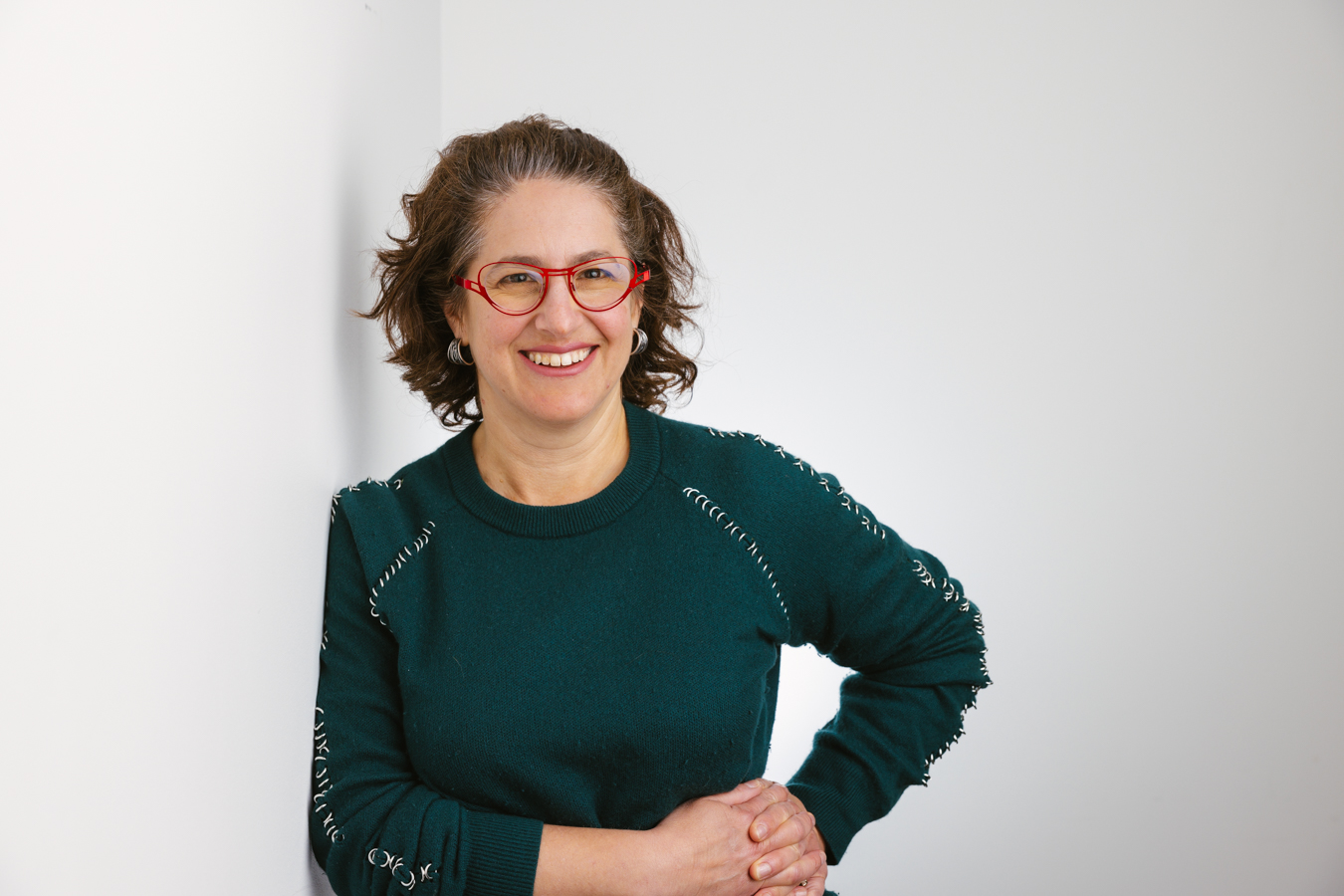
‘Thinking is your superpower,’ said Professor Lyria Bennett Moses to students when she came back to Ascham as Prizegiving guest speaker in 2024.
‘The big problems—cybersecurity, climate change, peace, the future of humanity—all require bringing together many different ways of thinking. Learn as many as you can,’ Lyria said to a packed audience of attentive Senior students.
Lyria Bennett Moses (1993) is the perfect Ascham alumna to serve this proposition to Ascham girls. As a Professor at UNSW Sydney, Lyria’s work considers the big questions around the law and its relationship with technology, especially AI, cybersecurity and data. Crucially, Lyria’s work has a distinct humanities and ethics foundation. Listening to Lyria speak in various interviews and the TEDx talk she delivered, it’s clear that centring humanity, challenging bias and considering historical fact and context are all principles from which she works.
Lyria’s recent work on the legal, regulatory and policy issues associated with artificial intelligence, including the use of AI in courts and tribunals, comes at a time when AI is ubiquitous across many aspects of work and life. For Lyria, it’s about understanding the problems we’re trying to solve and the different options for legal intervention before simply regulating a particular set of technological artefacts or practices. The answer to the problems raised by generative AI, including large language models, may be something other than legislation to regulate ‘artificial intelligence’ as such.
On a Technology and Security podcast last year, Lyria spoke about the multi-faceted thinking that is required in this sphere: ‘What we’re seeing are complex human-technology systems,’ she said. ‘It’s not purely technical or purely human. There’s an important technology literacy that I would argue needs to be taught more and more in high school. It’s not necessarily how to program a computer or how to build an AI system. It’s really understanding enough about how different kinds of systems work, so that you have a sufficient sense of what they do and what their limitations might be.’
Lyria is putting these ideas into effect in her new role as Academic Director of Research in the Division of Research and Enterprise at UNSW, where she will support researchers to use AI thoughtfully in light of its capabilities, affordances and limitations.
Lyria’s cross-disciplinary approach can be traced back to her passion for debating, public speaking and mathematics, the latter fostered in the classroom of Miss Janet Hunter (Miss Parker at the time, who was known as ‘Ma’am’ by the time Lyria’s daughter Tiana Moses attended Ascham, and who retired from Ascham just last year). After being named equal Dux in Year 12, and achieving a perfect TER of 100, Lyria combined her love of maths, science and law at UNSW, graduating with First Class Honours and the University Medal in Pure Mathematics.
After a short period working at Sydney law firm Freehills and as an associate for The Hon. Justice Margaret Stone AO FAAL (former Chair of Ascham’s Board of Governors) in the Federal Court, Lyria and her husband headed to New York. Lyria completed her doctorate at Columbia Law School on the topic ‘The Impact of Technological Change on Law’.
Australia has benefitted from her expertise ever since.
Lyria is widely published, contributes to public policy, standards and discourse, and serves on several editorial boards. With Dr Michael Guihot, she co-authored the book Artificial Intelligence, Robots and the Law, now in its 2nd edition. Lyria is a Fellow of the Academy of the Social Sciences in Australia, the Australian Academy of Law and the Royal Society of NSW.
Lyria argues for appropriate legal constraints, protection of privacy and autonomy, rigorous testing and evaluation, transparency, practical standards and the need for citizens to have sufficient knowledge to be able to question the systems governing them. Her TEDx talk in Sydney in 2022 brought into sharp focus some of the consequences of neglecting these standards. She examined the US’s COMPAS criminal risk-assessment tool, China’s social credit system, and the Australian government’s disastrous Robodebt scheme that operated from 2015 to 2019.
‘It’s not actually how technologically sophisticated the tool is,’ Lyria said, ‘it’s about centring human needs and human rights in the systems that governments build. Governments are increasingly relying on algorithms to decide how to allocate resources or to provide services. The Australian government introduced its AI ethical principles while it was still actively pursuing Robodebt… We need to build constraints into the legislation that authorises the use of these kinds of systems to require things like proper testing, evaluation and full transparency. We need protection for privacy and autonomy, as the foundation of human dignity. We need standards with enough detail so that organisations can create practical policies for designing, using and purchasing AI systems. And we need citizens to understand the kinds of problems I’ve been talking about and the values that we need to protect, so that they stop government from putting out either flawed or inappropriate systems.’
Deep thinking and embracing failure as key elements for growth and learning are messages for today’s students that can be gleaned from Lyria’s journey. ‘Failure was my best motivator,’ she said when reflecting on her Ascham days. ‘That’s where the Dalton Plan truly shone. When an assignment or exam bombed, Studies were an amazing opportunity for one-on-one teacher feedback, helping you get back to a place of this makes sense.’
For Lyria, the capacity to question, test, think and argue across disciplines has become increasingly consequential for living with contemporary technology. Her work asks us to pay attention to the assumptions embedded in the systems we rely on, to understand who has the power to make the choices that impact our lives, and to remain alert to their consequences for human dignity, fairness and autonomy. Lyria’s message to Ascham students indeed applies to each and every one of us: ‘Thinking is your superpower. Learning how to be thoughtful and to ask the right questions is not only essential for achieving personal goals; it can preserve the essence of humanity in shaping and thriving alongside machine “intelligence”’.
Bibliography:
Bennett Moses, L (2024) Ascham Senior School Prizegiving Speech
Bennett Moses, L (2022) ‘Should we worry about AI and algorithms in government?’ TEDxSydneySalon
Hammond-Errey, M (2025), ‘Governing the unseen. AI, law, power and complexity with Prof Lyria Bennett Moses’, Technology and Security podcast
Wenderoth, A (2024), ‘Professor Lyria Bennett Moses – A Trailblazer in Law and Technology’, Ascham Old Girls eNews / Ascham website
Read our previous instalments of 14 Decades of Stories:
Pioneering feminist and first Ascham student Inez Bensusan
Brilliant scholar Ethel Lane Latham, who was the highest scoring female student in NSW in 1894 and 1895
Bessie Bundock, co-founder of Ascham’s yearbook, Charivari, which has become the School’s continuous primary historical record for over 120 years
Rania MacPhillamy MBE OBE operated vast rest homes for wounded soldiers in Egypt during World War I
An original Ascham audio drama brings to life the 1915 letters of Ursula Carter who worked as a nurse during World War I
Mother and daughter Linda and Patricia Littlejohn, who smashed the glass ceiling in university and empowered women across society
Ascham Old Boy Lloyd Poulton, who was one of a handful of boys who were enrolled at Ascham early in the 20th century
Inspiring obstetrician and gynaecologist Dr Joan Storey, whose determination and excellence opened doors for women in medicine
After overcoming a life-changing accident, Charlene Meade OAM became a Paralympic pioneer
One of Australia’s most influential radiologists and medical researchers Dr Janet McCredie AM
The life of Belinda Hutchinson AC has been one of generosity, leadership and service
Shemara Wikramanayake has redefined what’s possible in leadership in the four decades she served as CEO for Macquarie Group